


Parenting and Support
Deciding How to Communicate with Your Child
Have you just found out that your baby is deaf or hard of hearing, and you want to learn how to "talk" to him? Are you wondering if it's better to speak or use sign language, or maybe both? Read on to find out more…
Adults and children use language(s) (e.g., English, Spanish, French, American Sign Language, British Sign Language) to express their ideas and to communicate with others. Babies and parents share a common language so that they can understand each other. Hearing babies begin to pay attention to the language(s) around them in the first few months of life. Similarly, deaf babies who have deaf parents also begin to pay attention to their parents' use of sign language in the early months of life. These natural models in the home (spoken or signed) encourage the child to learn language.
When parents are hearing and their babies are deaf or hard of hearing, they need to find effective ways to communicate and model language for their babies.
- The family must find forms of communication that everyone can understand.
- Decisions about how to communicate in your family are very important to your child's early development.
Because each baby and family is different, decisions about how to communicate must be made carefully, based on your baby's and family's needs. Approaches vary in the amount of emphasis placed on listening, spoken language, and/or visual approaches. Sometimes one approach works for children. Sometimes combinations of communication styles are more appropriate. Decisions about how to communicate are not usually “either-or" (either this one or that one); many families combine various approaches in response to the child's needs over time.
The information in the following section was contributed by a team that developed a website for families focused on “raising deaf kids" (see
About Us). It may have been edited or updated from the original.
What is communication?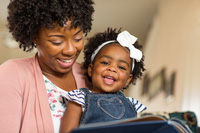
- Communication is sharing ideas. Many people think it's just talking.
- But real communication happens when you understand other people, and they understand you.
- Communication is more than words.
- You communicate by smiling, frowning and the expressions on your face. You also do it by the way you stand, and by how you move your body.
How to choose ways to communicate
- Accept that each family is different.
There isn't a "right" choice for all children.
Each child is different and needs different things.
Parents are also different and have their own hopes for their children. Some families are able to do one thing.
Some families are able to do another. - Be flexible.
Follow your child's lead.
You may feel stressed out over choosing from the various options that are available. Many parents find that the best choice is to follow their child's lead.
Some parents even combine ways of communicating. It's important to be flexible.
Children's needs change over time, and may families adjust approaches over time in response to those changing needs. - Ask yourself these questions:
- How much can your child hear?
- Does your child get mad quickly when you don't understand him?
- Are you willing to learn a new language?
- How much time can you give to help your child learn?
- How important is it to you that your child learns to speak clearly?
- Are there programs for the different options where you live?
- What do other parents and professionals say about those programs?
|
Reminder |
|
Information in the following section was developed by the www.babyhearing.org team (See About Us)
Any decisions will require commitment from you and from the professionals on your baby's team. You may see people refer to this as "communication modalities." This means whether communication will be through auditory, visual, or combined routes. The list of common communication approaches below is ordered from most auditory to most visual.
Auditory-to-Visual Communication Continuum
We often think of these approaches on a continuum from auditory (A) emphasis in learning to visual(V) emphasis in learning. By considering the child's unique learning strengths and needs, parents and communicators can use the best approach(es) for the child. Children might start at one place on the continuum and move to different points on it as their needs change.
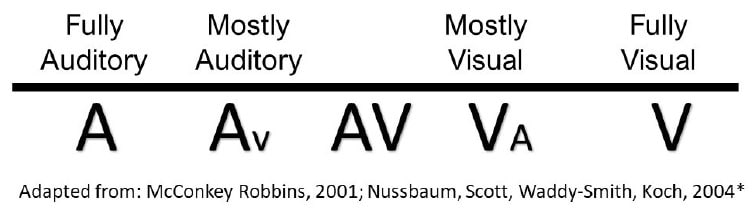
- A and Av: place a lot of emphasis on learning to listen through the auditory (hearing) sense. Promote reliance on hearing aids and/or cochlear implant technologies.
- Av: A lot of listening practice with some visual support, like speech reading.
- AV: Equal emphasis on auditory and visual learning. This might be a child who is learning spoken language with the support of Cued Speech, or learning sign language and spoken language.
- VA and V: Some children learn best with more emphasis on visual communication. These might be children who mostly rely on sign language, but also benefit from some auditory stimulation (VA), or primarily learn through American Sign Language (V) or use American Sign Language and learn English through reading and written language (see Bi-Lingual Bi-Cultural section).
Communication Styles and Languages
Listening and Spoken Language (LSL)
(also known as auditory-verbal or auditory-oral)
For helpful information on the LSL approach, visit:
Cued Speech
For helpful information on the Cued Speech approach, visit:
Combined Approaches (Speaking and Signing)
For more information, visit:
American Sign Language (ASL)
For helpful information on ASL, visit:
Bilingual-Bicultural* *The information in the following section was contributed by the team that developed a website website for families focused on “raising deaf kids” (see
About Us). It may have been edited or updated from the original.
*The information in the following section was contributed by the team that developed a website website for families focused on “raising deaf kids” (see
About Us). It may have been edited or updated from the original.
Bilingual-biculturalism (bi-bi) is based on the idea that deaf children need access to a language they can see. It is also believed that once children learn one language, they can pick up other languages with greater ease. For helpful information on the Bilingual-Bicultural approach, visit:
A Lot Depends on the Learning Needs of Your Child
Information in this last section was developed by the www.babyhearing.org team (See About Us)
Sometimes families will find a single form of communication works best, and other families may use more than one form. For example:
- One family may choose listening and spoken language methods for a child who is going to receive a cochlear implant at one year of age. Another family in this situation may sign to the baby until the implant is received, and then transition to spoken language approaches. Others may sign before and after the cochlear implant.
- A baby with both deaf and hearing family members may learn sign language while also relying on hearing to develop spoken language.
- Another child may speak clearly but do best with a sign language/educational interpreter in noisy settings, like in school.
- It is important to remain flexible and observe whether or not the approaches you are using are working well for your child. Ongoing evaluation can guide modification of approaches as needed.
Resources
- www.cuedspeech.org and the Cue College link at infanthearing.org
- www.handsandvoices.org - see Communication Considerations A to Z
*McConkey Robbins, A. (2001). A sign of the times: Cochlear implants and total communication. Advanced Bionics Loud & Clear (4)2, 1-7.
*Nussbaum, D., Scott, S., Waddy-Smith,B., & Koch, M. (2004). Spoken language and sign: Optimizing learning for children with cochlear implants. Paper presented at Laurent Clerc National Deaf Education Center, Washington, DC.